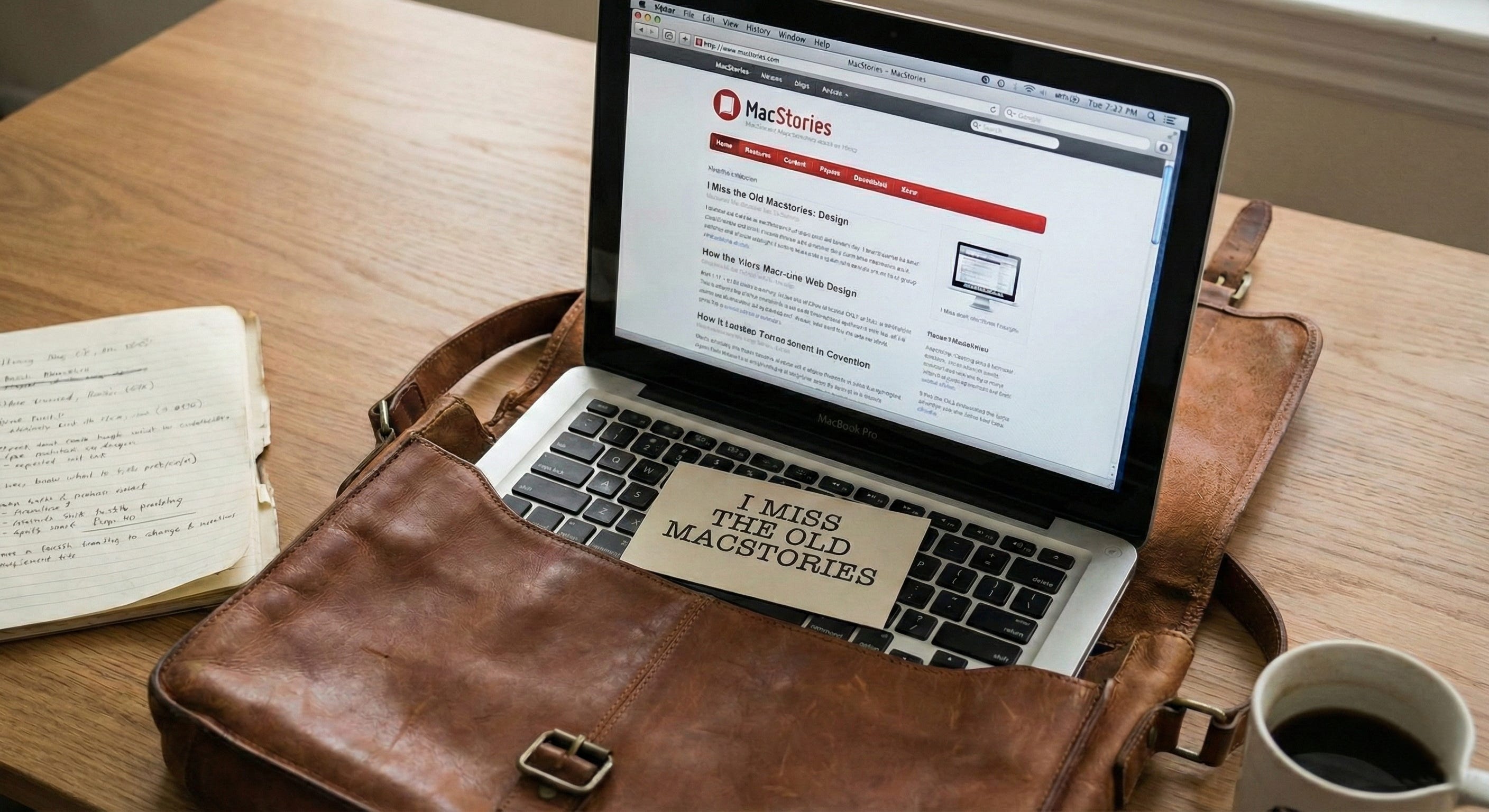
I Miss the Old MacStories
How AI and Expensive Hardware Replaced the Tinkering Spirit I Loved
I used to refresh MacStories like a nervous tic.
I’d be sitting there with my coffee, way too early in the morning while the house was still quiet, waiting for Federico or John to drop some new automation workflow that would fundamentally change how I used my iPad. Those guys didn’t just review apps — they broke them open. They showed us how to bend iOS to our will, how to turn a pane of glass into a legitimate workstation. Toolbox Pro actions. Scriptable file bookmarks. Shortcuts that chained together six apps to achieve something Apple never intended. It was tinkering at its finest. Loving the machine enough to grapple with it.
I remember spending an entire Saturday afternoon rebuilding Federico’s MusicBot shortcut from scratch, not because I needed it to work exactly like his, but because I wanted to understand how he thought about the problem. The shortcut itself was absurd — hundreds of actions, nested menus, conditional logic that made my head spin. It saved me maybe ten seconds when queuing up an album. I didn’t care. The point was the craft. The point was that someone had looked at the Shortcuts app and said, “I bet I can make this do something it was never designed to do,” and then spent weeks proving themselves right.
That energy is what made MacStories special. It wasn’t just app reviews. It was a philosophy. The iPad wasn’t a lesser computer — it was a different computer, one that rewarded patience and ingenuity. Federico’s annual iOS reviews were legendary not because they were comprehensive, but because they treated the operating system like a puzzle worth solving. Every new feature was an opportunity. Every limitation was a challenge.
Lately, though? The magic feels different.
MacStories has pivoted hard toward AI. And I get it — AI is where the industry is right now. It’s the shiny new conversation, the thing investors care about, the thing that drives clicks. But in chasing that wave, I feel like they’ve left behind the very charm that made the site special in the first place.
Don’t get me wrong. I use AI. I rely on it for parts of my workflow. Claude helps me draft emails when I’m brain-dead at the end of a long day. I’ve used ChatGPT to debug Python scripts I barely understand. I’m not a purist. But I didn’t go to MacStories to learn how to have a computer write an email for me. I went there to learn how to use the computer. There was a specific joy in the Rube Goldberg machines they used to build with Shortcuts — complex, fragile, beautiful little systems that saved you three seconds but took four hours to build. That was the point. The destination mattered less than the journey.
Now the feed is flooded with AI content. Federico talks about building “12 web apps” over the holiday break by steering Claude Code. John wrote a piece about reviving a decade-old app using Claude, and to be fair, he does walk through the technical steps — parakeet-mlx for transcription, Python scripts for dictionary corrections, Claude Skills for the final fuzzy pass. It’s detailed. It’s useful. But there’s something that feels different about it. The old MacStories taught us to fish. This version feels more like showing us the fish they caught and the expensive rod they used to catch it.
Matt Birchler wrote a piece that MacStories linked to called “LLMs Have Made Simple Software Trivial.” The premise is that you can think of an app while on a run, dictate the concept into your phone, and have Claude build it by the time you get home. And Federico’s response was essentially: yes, I’m doing this already, and so should you. He mentions “scaffolding” and “steering” the AI, phrases that sound technical but don’t quite land the same way as a 3,000-word breakdown of Shortcuts parameters. The granular, nerdy details — the “here’s exactly how you replicate this” energy that used to define the site — feel thinner now.
Maybe that’s inevitable. Maybe there’s only so much you can write about prompting an AI before it all sounds the same. But I miss the specificity. I miss learning that you could use Scriptable to access file bookmarks in ways the Files app couldn’t. I miss the revelation that Working Copy could turn your iPad into a legitimate Git client if you were willing to put in the work.
And then there’s the money.
I recently read their “Final 2025 Setups Update,” and it’s a lot to take in. John bought a GMKtec EVO-X2 mini PC with a Strix Halo processor, 64GB of RAM, and a 2TB SSD. He paired it with a 32” ASUS ROG Swift 4K OLED gaming monitor, a Philips Hue Play HDMI Sync Box 8K, and enough smart lighting to make his office look like a Twitch streamer’s dream. Federico upgraded to a 77” LG G5 OLED TV — the flagship model with Tandem OLED technology — along with Bowers & Wilkins Px8 S2 headphones, a Bluetooth dongle to override Apple’s SBC codec, and a Sonos Move 2 for good measure. They mention taking advantage of Black Friday deals, but even at 50% off, we’re talking about thousands of dollars in hardware.
It’s impressive. I’m not going to pretend otherwise. But it’s also a different vibe than what drew me to the site in the first place.
MacStories used to be about democratization. The implicit promise was that you could take a basic iPad Air and turn it into a powerhouse through sheer cleverness and software optimization. The constraints were the point. You didn’t need expensive hardware — you needed patience, curiosity, and a willingness to dig into obscure settings menus. The site made you feel like the tools you already owned were capable of more than you realized.
Now it feels more like gadget porn. Setups that assume you can drop a few thousand on hardware just to test a workflow. Mini PCs running Bazzite. OLED monitors with 240Hz refresh rates. Audiophile headphones that require a special dongle to work properly with an iPhone. I’m sure it’s all wonderful. I’m sure the experience is incredible. But it’s hard not to feel a disconnect when you’re reading about someone’s third specialized computer for their dedicated home office and you’re just trying to get some writing done on the one laptop you can afford.
The podcasts have shifted too. Shows like Comfort Zone feel less urgent than they used to. There’s something manufactured about them now — lifestyle content rather than problem-solving. I used to feel like I was eavesdropping on two experts working through a puzzle together. Now it feels more like content for the sake of content, filling a release schedule rather than answering a burning question.
Maybe I’m just being I’m becoming an older man yelling at a cloud. Maybe the era of manual optimization is dead, and I’m clutching onto a corpse. iOS and iPadOS has matured. The rough edges have been sanded down. There are fewer workarounds to discover because Apple has filled in most of the gaps. The people who used to obsess over Shortcuts have moved on to obsessing over Claude, and maybe that’s just how it goes.
However, I miss the friction. I miss the deep dives into iPadOS quirks that had nothing to do with Large Language Models and everything to do with making a rigid operating system dance. MacStories used to be a celebration of the platform’s constraints. Now it feels like they’re bypassing them entirely — with expensive hardware and black-box code generation.
It’s cleaner now. More professional. More current. The production values are higher and the scope is broader. But every time I visit the site lately, I leave feeling a little less inspired to open my laptop and make something. The spark that used to send me down rabbit holes of automation and tinkering just isn’t there anymore.
And that, at least for me, is a damn shame.