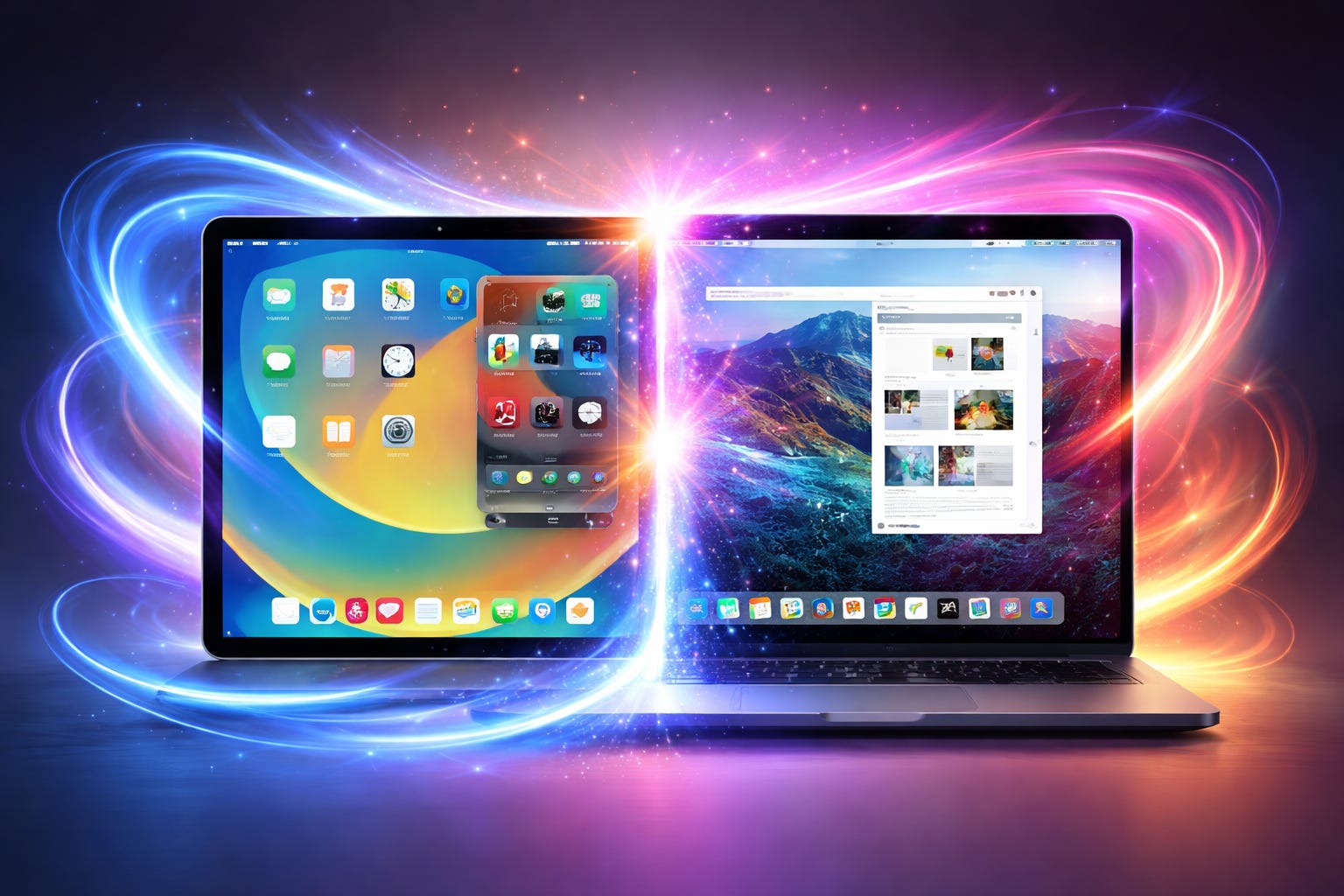
What If iPadOS 27 Is Actually macOS 27?
Apple’s Touchscreen Mac Convergence Theory
I’ve been watching Apple’s moves for the past year with increasing suspicion. Not the fun kind, where you wonder if they’re going to surprise you with something delightful. The kind where you start connecting dots that Apple probably doesn’t want you connecting yet.
Here’s what we know: Apple is reportedly working on a touchscreen MacBook Pro for late 2026 or early 2027. Ming-Chi Kuo and Mark Gurman have both corroborated this. Samsung has already started production on the OLED panels. The redesigned laptops will have OLED displays, a Dynamic Island replacing the notch, reinforced hinges that don’t wobble when you touch the screen, and M6 chips built on TSMC’s 2nm process.
Meanwhile, iPadOS 26 just completely overhauled how iPads work. We got Mac-style traffic light buttons for windows. Actual menu bars that swipe down from the top. Exposé. Windowed apps that you can resize and stack and arrange however you want. The Files app looks more like Finder now. Apple essentially rebuilt the entire multitasking system from scratch to work like, well, macOS.
And both platforms run on Apple Silicon. The same chips. The same architecture. The same fundamental hardware.
So here’s my question: What if iPadOS 27 and macOS 27 are the same thing?
Steve Jobs Was Right (Until He Wasn’t)
Before we go further, let’s acknowledge the elephant in the room. Steve Jobs famously dismissed touchscreen laptops in 2010. “We’ve done tons of user testing on this, and it turns out it doesn’t work,” he said. “Touch surfaces don’t want to be vertical. It gives great demo, but after a short period of time you start to fatigue, and after an extended period of time, your arm wants to fall off.”
He called it “gorilla arm syndrome.” And he wasn’t wrong, at least for the way people used computers in 2010. The Windows 8 touchscreen laptops that followed were largely mediocre, trying to force touch interfaces onto software designed for mice and keyboards.
But here’s the thing. Apple has spent the past decade building toward a different answer. The M-series chips erased the performance gap between iPad and Mac. The Magic Keyboard turned iPad Pro into something that feels shockingly laptop-like. And iPadOS 26’s new windowing system isn’t just “inspired by” macOS. It uses the same traffic light buttons. The same window tiling options. The same Exposé gestures.
Apple isn’t just making iPadOS more Mac-like. They’re making the two platforms interchangeable.
The Touchscreen MacBook Changes Everything
Here’s where it gets interesting. The touchscreen MacBook Pro rumored for late 2026 isn’t just adding touch to a Mac. According to reports, Apple is building the machine from the ground up to be touched. Reinforced hinges so the screen doesn’t bounce. On-cell touch technology built directly into the OLED panel for better precision. Palm rejection that actually works.
And crucially, Gurman has said Apple isn’t planning major interface changes to macOS for the touchscreen. Touch will be “additive,” a complement to the trackpad and keyboard rather than a replacement. You’ll still click tiny menu items with your cursor. You’ll just also be able to tap the screen when that feels more natural.
But wait. That’s exactly how iPadOS 26 works with a Magic Keyboard. You can use the trackpad for precise work and touch the screen when that’s faster. The traffic light buttons are designed to work with both input methods. The menu bar appears whether you’re using fingers or a cursor.
Apple hasn’t just made iPadOS more Mac-like. They’ve made macOS more iPad-like. The interfaces are converging from both directions.
The “Snow Leopard” Release
Multiple sources have described iOS 27 and macOS 27 as “Snow Leopard” releases, focused on performance, stability, and cleaning up technical debt rather than flashy new features. Mark Gurman reported that Apple engineers are “looking for bloat, bugs, and any other issues impacting performance.”
Here’s what nobody’s saying explicitly but seems obvious: this is the release where Apple finishes dropping Intel support and can finally clean house. The A14-based cutoffs rumored for iOS 27 would align perfectly with the first M1 Macs. Every supported device would share the same fundamental architecture.
If you’re going to merge two operating systems, you’d want to first clean up all the legacy code that makes them different. A “Snow Leopard” release is exactly how you’d prepare for that kind of fundamental change.
What Would It Actually Look Like?
I don’t think Apple would announce “iPadOS and macOS are now the same thing.” That’s not how they operate. They’d probably call it something like “Universal Interface” or “One Experience” and frame it as the natural evolution of both platforms.
The operating system would detect what hardware it’s running on. On a MacBook with no touchscreen, you’d get the traditional macOS experience, unchanged. On a touchscreen MacBook Pro, you’d get macOS with touch capabilities enabled. On an iPad with Magic Keyboard, you’d get the full windowing system with cursor support. On an iPad without accessories, you’d get the touch-first interface we’re used to.
Same OS, different modes depending on context.
This isn’t even unprecedented. Microsoft tried it with Windows 8 and failed, but the failure was in execution, not concept. They forced tablet interfaces onto desktop users who didn’t want them. Apple’s approach would be smarter. You’d only see touch-friendly elements if you’re actually touching the screen.
iPadOS 26 already works this way. The traffic light buttons stay tiny when you’re using a trackpad but expand when you tap them with your finger. The interface adapts to how you’re using it.
Why This Makes Business Sense
Apple has a problem they don’t talk about publicly: the iPad has been cannibalizing Mac sales for years, and neither product has really benefited. The iPad Pro is powerful enough to replace most people’s laptops but can’t run “real” software. The MacBook is capable but feels dated compared to touch-first devices.
A unified OS solves this. The iPad Pro with Magic Keyboard becomes a legitimate laptop replacement because it runs the same software as Macs. The touchscreen MacBook becomes a legitimate creative tool because touch input finally works. Developers only have to maintain one app that works everywhere, not two separate versions optimized for different input methods.
Apple Creator Studio, which just launched, already works this way. Final Cut Pro, Logic Pro, and Pixelmator Pro run on both Mac and iPad, with the same AI features on both platforms. The apps travel with you. The work lives in the ecosystem, not on a single device.
That’s the future Apple is building toward. The hardware becomes interchangeable. The OS adapts to whatever device you’re using. Your workflow doesn’t change when you switch from iPad to Mac because they’re running the same thing.
The Timeline
If I’m right, here’s how it plays out:
WWDC 2026 (June): Apple previews macOS 27 and iPadOS 27 separately but with suspiciously aligned feature sets. Both emphasize performance and stability. macOS 27 includes subtle interface changes that make it more touch-friendly, though Apple won’t explicitly say why.
Fall 2026: The touchscreen MacBook Pro launches. Apple emphasizes that touch is “additive” and the Mac experience remains unchanged for those who don’t want touch. But the operating system clearly supports both input methods seamlessly.
2027 or beyond: Apple announces that iPadOS and macOS are converging into a single platform. The iPad Pro running on M-series chips can optionally boot into the “full” desktop experience. The distinction between tablet and laptop becomes purely about form factor, not software capability.
Why I Might Be Wrong
Apple has repeatedly said they’re not merging iOS and macOS. Greg Joswiak shot down the idea when the M1 iPad Pro launched. Tim Cook has compared the idea to “converging a toaster and a refrigerator.”
But Apple also said they’d never make a stylus for iPad. They said 3.5-inch was the perfect phone size. They said MacBooks didn’t need USB-C ports. Companies change positions when circumstances change.
The circumstances have changed. iPadOS and macOS already share the same chip architecture, the same interface elements, and increasingly the same apps. The software has been converging for years. The touchscreen MacBook is the hardware that finally makes full convergence possible.
I could be wrong. Apple might keep the platforms separate forever, maintaining two operating systems that look and work almost identically but remain technically distinct. That would be classic Apple, doing things the hard way because they believe it’s the right way.
But I don’t think so. I think iPadOS 27 and macOS 27 are laying the groundwork for something bigger. I think the touchscreen MacBook isn’t just a new product, it’s the bridge that connects Apple’s two computing platforms into one.
And honestly? It’s about damn time.


