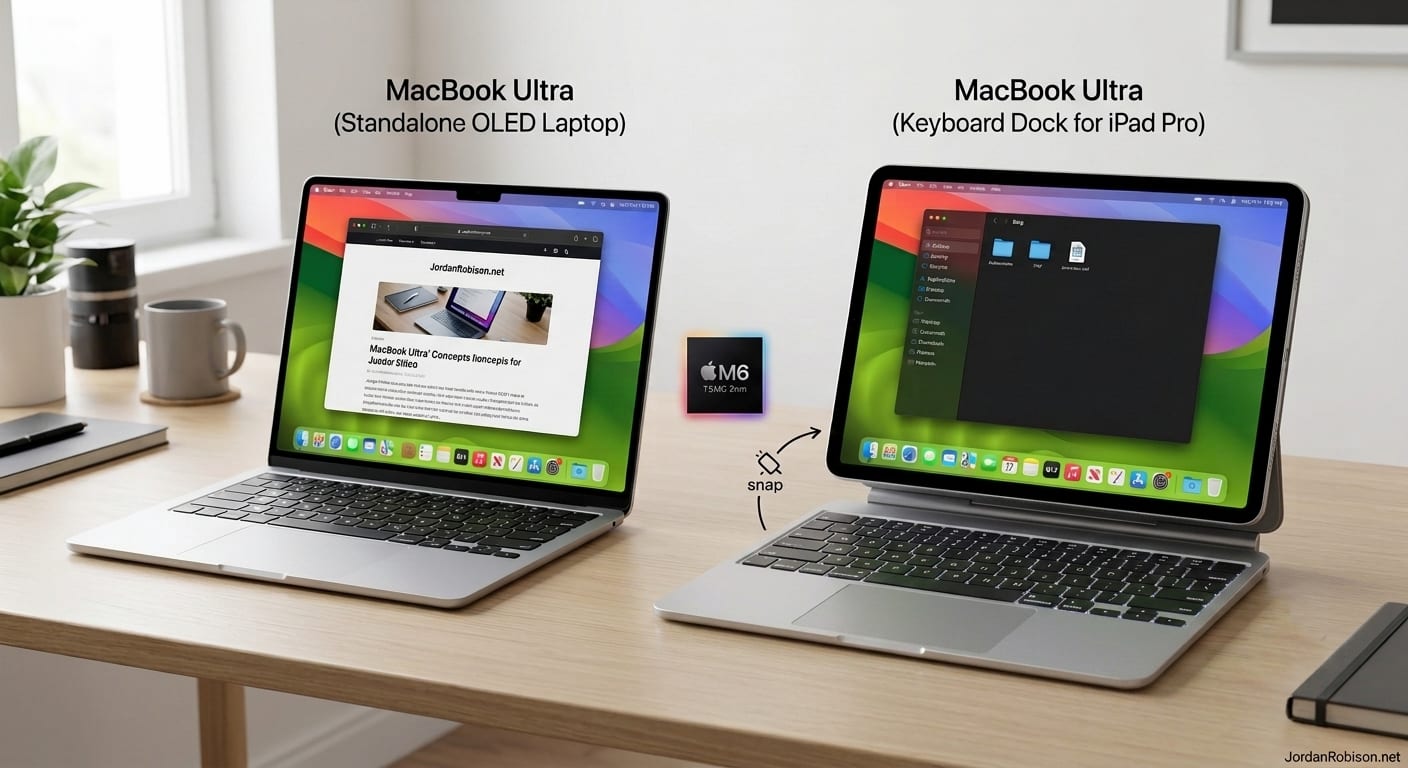
What if the MacBook Ultra is Also an Ultra Keyboard for the iPad Pro?
A theory I had to write down before it becomes confirmed or mere fantasy — what if Apple's thinnest MacBook ever is also a keyboard base that turns your iPad Pro into a Mac?
I was sitting in my home office reading through WWDC 2026 coverage when it hit me, one of those ideas that feels so obvious once it arrives that you can’t believe no one’s said it out loud yet. And maybe someone has. But I hadn’t seen it, so I’m saying it now before it either gets confirmed or gets laughed into the ground.
What if the MacBook Ultra is two products?
Not two SKUs with different RAM configurations. Two fundamentally different devices that share the same chassis. Version one is the one everyone’s been writing about for the last eighteen months: a premium laptop with a tandem OLED touchscreen, M6 Pro and M6 Max chips, and a notably thinner and lighter design than today’s MacBook Pro. The obvious successor. The thing Apple has to make. Version two is something nobody’s talking about, and it’s the version that’s been living rent-free in my head since I read about WWDC 2026’s continued slow march toward iPad and Mac convergence.
Version two is a Magic Keyboard with an entire MacBook computer underneath it, designed to attach to your iPad Pro and use the iPad as its display.
I know how that sounds. Bear with me.
The setup Apple has built toward, piece by piece, is almost too deliberate not to notice when you lay it all out. With iPadOS 26, Apple gave the iPad real windowing, free window resizing, and a proper arrow cursor when a trackpad is connected, along with the Mac-style red-yellow-green buttons for closing and minimizing windows. iPadOS 27 is expected to continue that slow convergence with macOS, especially around windowing and external display support. The gap between what the iPad looks like and what a Mac looks like is narrowing every year. Apple has been doing this intentionally. The question I keep asking myself is: narrowing toward what?
And then there’s the hardware side. Apple has pitched its 2026 strategy as a “return to design roots,” highlighting thinner hardware, premium materials, and a renewed focus on aesthetics and engineering working closely together. That’s the spirit Jony Ive was pushing when he was still at Apple, the relentless thinness obsession that his critics said was killing usability and his admirers said was the whole point. The MacBook Ultra rumors line up perfectly with that: the MacBook Ultra is expected to be noticeably thinner and lighter than current MacBook Pro models, featuring Dynamic Island instead of a notch, M6 Pro or M6 Max silicon, and the first-ever touchscreen in a MacBook. The thermal engineering alone to make that possible is significant. If the chassis is as thin as rumored, those chips will be running within tighter thermal limits, and physics doesn’t care about marketing copy.
So Apple is building the thinnest Mac they’ve ever made, with chips powerful enough to run serious workloads. And they’re building an iPad that looks and behaves more like a Mac every single year. Two products converging toward each other. At some point, they meet.
My theory is that the MacBook Ultra keyboard body is where they meet.
Think about what you’re actually holding when you pick up a Magic Keyboard for iPad Pro. It connects through the Smart Connector, requires no setup or pairing whatsoever, draws power from the iPad, and transforms the iPad into something that looks and functions like a single entity. That’s not an accessory. That’s a dock. Apple has spent years making the Magic Keyboard physically, functionally, and aesthetically indistinguishable from a laptop bottom half. What I’m asking is: what if the next step is that the keyboard half actually is a laptop?
The M6 chip, built on TSMC’s 2nm process, is expected to deliver significant performance and efficiency gains. If Apple has finally cracked the thermal engineering to make a chip that powerful run in a chassis thin enough to be called “Ultra,” that same chip could theoretically live in a keyboard base without needing the kind of fan stack a traditional laptop requires. The keyboard body’s thickness has always been constrained by the trackpad and key travel requirements anyway. You’d have volume to work with. Maybe not a lot. But potentially enough.
And here’s the part that makes the whole thing click for me: the iPad Pro already has a display that would embarrass most laptops. The M5 iPad Pro’s OLED panel is, by most accounts, the best display Apple makes. If you’re building a MacBook that uses an external display, why would you ship it with a worse screen than the one your customer might already own? You wouldn’t. You’d let them use the screen they have.
There’s a version of this product that makes complete sense as a business decision too. Apple has a problem they’ve never quite solved: the iPad Pro is too powerful to be a toy and too locked down to be a computer. The Magic Keyboard already transforms the iPad Pro into something that looks and functions like a laptop alternative with backlit keys, a haptic trackpad, and seamless magnetic attachment. But at the end of the day, you’re still running iPadOS. You’re still in the walled garden. A MacBook Ultra keyboard base would fix that without Apple ever having to admit that iPadOS has limits. The iPad stays the iPad. The keyboard base runs macOS. Snap them together and you get a Mac. Detach and you get an iPad. It’s the dream Apple has been gesturing at for a decade without ever fully committing to it.
Don’t get me wrong, I have no inside information. I’m just a guy who’s spent years trying to stretch the iPad Pro past what Apple will let it do, finding workarounds for the limitations I wrote about a few weeks ago, so maybe I’m primed to see a resolution to that tension where one doesn’t exist. It’s possible this is wishful thinking dressed up in rumor-adjacent clothing. That happens.
But the convergence is real. macOS 27 is reportedly getting a dynamic user interface that adjusts on the fly, expanding touch-friendly elements when you tap the screen and staying compact when you’re using a cursor, which is exactly the kind of UI foundation you’d need if macOS is ever going to run comfortably on a device that doubles as a touch display. The pieces are all there. Apple just hasn’t told us what they’re building yet.
Maybe the MacBook Ultra is just a very thin, very expensive laptop with a touchscreen. Probably that’s exactly what it is. But I keep thinking about that keyboard body and all the empty space underneath it, and I keep wondering if Apple looked at the iPad Pro’s display and thought: why ship a screen twice?
I’ll know by the time this becomes either confirmed or mere fantasy. Either way, I needed to get it out of my head.