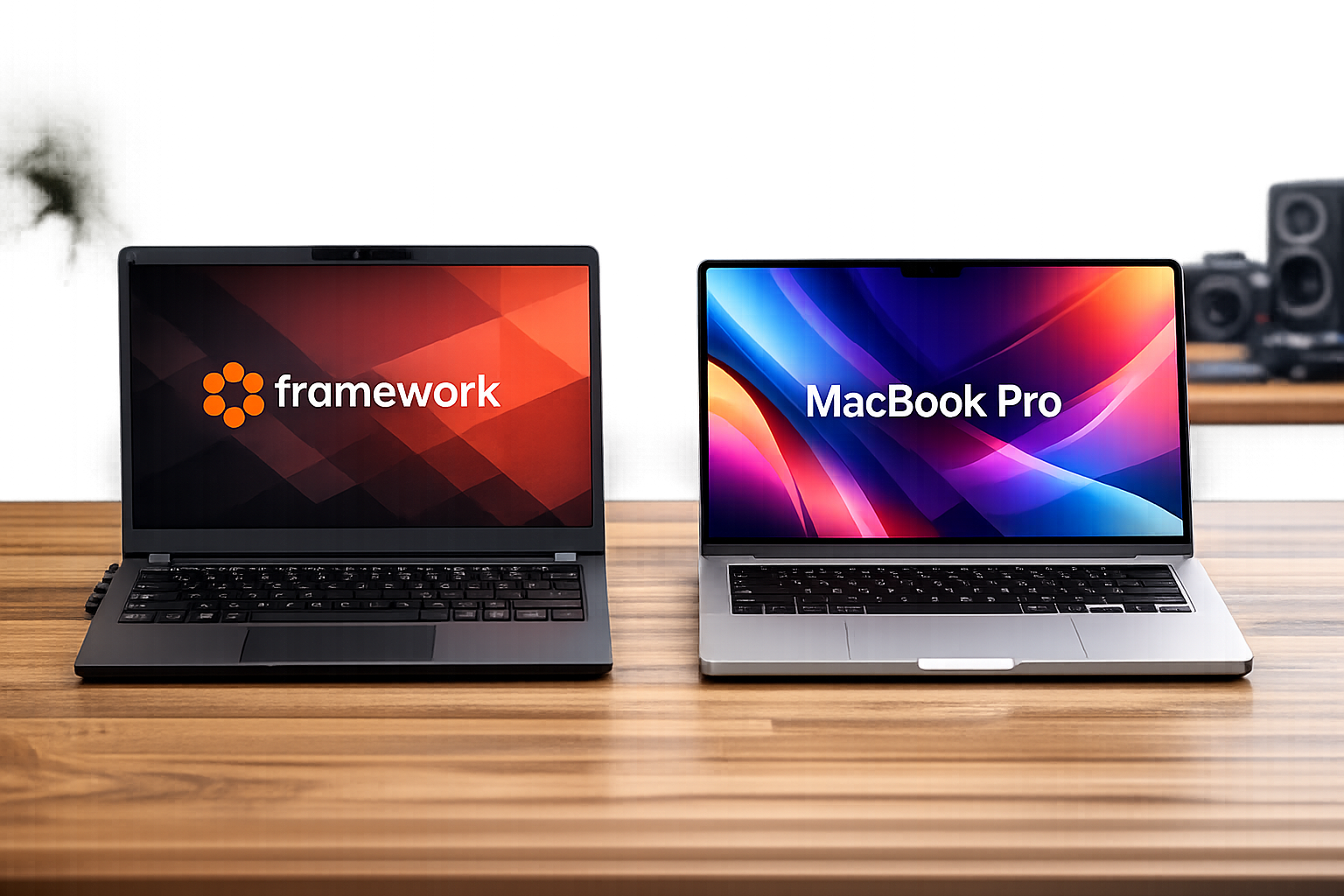
Why I'm Considering Framework Over Apple After Tim Cook's White House Visit
With the recent news of Tim Cook attending the private premiere of the abhorrent Amazon-financed documentary about the current first lady, Melania Trump, it got me thinking about the need to find alternatives to Apple.
I have been a lifelong Apple loyalist and fanboy since I was able to afford my first MacBook fresh out of college. And then I coveted the iPhone while using cheaper and more affordable Android phones until the day came when I found a deal that allowed me to purchase an iPhone via an installment plan. I’ve never been very rich. But the chance to be part of the Apple ecosystem was seen as a benefit rather than a luxury.
But now with the way the world is, it seems more important to put my money where my mouth is. Right now, I can’t afford to buy a new machine or phone. But if money were no object, where would I look for an alternative that represents the opposite of Apple, and is, to my knowledge, run by a CEO who is not kissing Trump’s ring finger?
Maybe Framework? Let’s dive in and compare.
The context here matters. On Saturday, January 25th, Border Patrol agents shot and killed Alex Pretti, a 37-year-old ICU nurse at the Minneapolis VA hospital. Pretti was a U.S. citizen with no criminal record, a lawful permit to carry, and was recording ICE agents on his phone when officers pepper-sprayed him, tackled him face-down, and shot him roughly ten times in five seconds. He was the second American killed by federal immigration agents in Minneapolis this month--Renee Nicole Good was shot dead by ICE just three weeks earlier. Minneapolis Police Chief Brian O’Hara noted that of the three homicides in his city this year, two were carried out by federal immigration enforcement.
Hours after Pretti’s killing, Tim Cook was at the White House watching a vanity documentary about the first lady, eating popcorn from commemorative boxes served by gloved waiters. He posed for photos with director Brett Ratner, who hadn’t directed a film since 2014 because six women accused him of sexual assault. Cook gifted Trump a 24-karat gold desk ornament on his last visit. It still sits on the president’s desk.
Cook’s internal memo to Apple employees two days later mentioned “the events in Minneapolis” without naming Pretti or criticizing the shooting. He called for “deescalation” and said he’d had “a good conversation” with Trump where he “shared his views.” He did not elaborate. The same Tim Cook who stood up to the FBI in the San Bernardino case. The same company that used to mean something.
So where does that leave someone who’s been buying Apple products for nearly two decades and now feels sick about it?
Framework is the obvious answer if you’re looking for an alternative built on different values. The company was founded in 2020 by Nirav Patel, who spent years at Apple and then helped build Oculus at Meta. He started Framework because, in his words, he felt “an increasing sense of unease about the direction the industry was going in.” The most advanced technology in human history was being designed to become expensive paperweights after a few years. Framework exists to fix that.
The company’s entire philosophy is right-to-repair. Their laptops are designed to be disassembled, upgraded, and fixed by the person who owns them. You can swap out the CPU, add more RAM, replace the battery, change the ports. When a new motherboard comes out, you buy the motherboard--not a new laptop. Framework sells replacement parts directly to customers and publishes step-by-step repair guides (Patel wrote 20 of them himself). The idea is that you buy once and upgrade indefinitely, rather than throwing away a perfectly good machine because Apple decided to solder everything to the logic board.
Patel isn’t kissing anyone’s ring. When Framework faced criticism last year over sponsoring some controversial open-source projects, his response was that they “deliberately create a big tent” to help open source software win, and they don’t partner based on political stances. That’s not nothing--it’s a philosophy of neutrality that some will love and some will hate. But it’s worlds apart from Tim Cook eating commemorative popcorn at the White House while federal agents kill nurses in Minneapolis.
Now for the honest part: a Framework laptop running Linux is not a MacBook Pro. It’s not close on several fronts, and pretending otherwise would be dishonest.
Battery life is the big one. MacBook Pro M3 chips get 17-plus hours in real-world testing. Framework laptops running Linux get 6-8 hours with aggressive power management--and you’ll need to install TLP and actually configure it. If you work untethered all day, this is a problem. I work from home most of the time, so maybe less of an issue for me, but it’s a genuine tradeoff.
The trackpad is another gap. Apple’s trackpad is the best in the industry, full stop. Framework’s is functional. You’ll probably need to tweak some settings to get it where you want it. It’s fine. It’s not the same.
And then there’s the ecosystem. I use an iPhone, an iPad Pro, AirPods, an Apple Watch. Everything talks to everything else. Airdrop works. Handoff works. My iCloud syncs seamlessly. With Framework on Linux, I’d be using Tailscale to sync with my iPad, running web apps for things that have native macOS versions, and probably cursing at something that just worked five minutes ago. The Apple ecosystem is a walled garden, but god, the garden is nice.
However, and here’s where it gets interesting, Framework’s approach has real advantages I’d actually use. The modular port system means I can swap in whatever I need: USB-A for old peripherals, HDMI for presentations, more USB-C when I need it. MacBook Pro gives you fixed ports and you deal with it. Framework runs Linux natively, which matters more for the developers I work with than for me directly—I'm a project manager, not someone pushing code. But I've sat in enough standups where Docker issues on Mac ate half the morning. There's something appealing about running the same OS my team deploys to, even if I'm not the one writing the scripts.
The specs are closer than you’d think. Framework Laptop 13 with the AMD Ryzen AI 9 handles compilation and development work admirably--Linux kernel compile in about 8 minutes, smooth performance in VS Code and JetBrains IDEs. MacBook Pro M3 Pro benchmarks higher on raw performance, but for my actual workflow (writing, research, some scripting, occasional heavy browser sessions), I wouldn’t notice the difference.
Price matters too. A mid-configured Framework runs about $1,500 and I can upgrade pieces over time. A comparable MacBook Pro starts at $2,000 and when something dies, I’m buying a new laptop.
The real question isn’t whether Framework is better than MacBook. It’s not, on pure user experience. The question is whether I can live with the tradeoffs to stop funding a company whose CEO photographs with convicted rapists and accused sex offenders at the White House while federal agents execute nurses in the street.
Okay, let’s get into the actual specs. Because if I’m going to make this switch, I need to know what I’m giving up and what I’m gaining.
The obvious comparison is the Framework Laptop 13 with the AMD Ryzen AI 9 HX 370 against the MacBook Pro 14-inch with M3 Pro. Both sit in roughly the same price range once you configure the Framework with decent specs, and both target the same general use case: portable machines for serious work.
The Hardware
The benchmarks tell an interesting story. On Geekbench 6, the Framework with Ryzen AI 9 HX 370 scores around 2,894 single-core and 12,924 multi-core. The MacBook Pro M3 Pro hits about 3,089 single-core and 14,029 multi-core. Apple wins, but not by the margin you’d expect given the hype. The M3 Pro is roughly 7% faster in single-threaded work and about 8% faster in multi-threaded benchmarks. For my actual workflow--writing, research, some scripting, browser tabs--I genuinely wouldn’t notice the difference.
However, there are areas where the gap is enormous and unfixable.
Battery Life: This Is the Killer
MacBook Pro’s 17+ hours of real-world battery life versus Framework’s 6-11 hours on Linux isn’t a small difference. It’s the difference between working all day untethered and carrying a charger everywhere. The 61Wh battery in the Framework isn’t much smaller than the MacBook’s 70Wh, but Apple Silicon’s efficiency is just on another level. The M3 Pro sips power. AMD’s Ryzen AI chips are more efficient than previous generations, but they still can’t compete.
If you’re running Linux on Framework, you’ll need to install TLP and configure power management properly. Even then, real-world reports from the Framework community suggest 6-8 hours for light productivity work, dropping to 3-4 hours under heavier loads. PCWorld’s testing got about 11 hours on video playback, but that’s best-case with display brightness lowered. Apple’s 17-hour claim holds up in actual use.
This matters if you travel. It matters if you work in coffee shops. It matters if you’re away from outlets regularly. For me, working from home most days, it’s less critical. But it’s honest to call this Framework’s biggest weakness.
The Display: Apple Wins, But Framework Is Fine
The MacBook Pro’s Liquid Retina XDR display is legitimately stunning. Mini-LED backlighting, 1600 nits peak HDR brightness, incredible contrast. If you’re doing professional photo or video work, it’s hard to argue with.
The Framework’s 2880x1920 120Hz matte display is... good. Not great. Reviews consistently praise the resolution and refresh rate but note the response time isn’t amazing for gaming and the colors aren’t as punchy as OLED or mini-LED panels. The 3:2 aspect ratio is excellent for productivity--more vertical space for documents and code. The matte anti-glare coating is practical if you work in varied lighting conditions. For writing, browsing, and general productivity, it’s perfectly adequate. For color-critical creative work, the MacBook wins decisively.
The Trackpad: Apple’s Moat
Apple’s Force Touch trackpad is the best in the industry. Period. It’s been the best for a decade. The haptic feedback, gesture support, and precision are unmatched.
Framework’s trackpad is functional. You’ll need to configure libinput settings on Linux to get it feeling right. It works. It doesn’t delight. This is one of those things where Apple’s hardware-software integration creates an experience that’s genuinely hard to replicate.
The Software Story
Here’s where things get philosophically interesting.
macOS is polished. Apps install cleanly, updates happen in the background, and everything integrates seamlessly with iPhone, iPad, and the rest of the Apple ecosystem. iCloud sync just works. AirDrop just works. Handoff just works. For someone managing projects, juggling browser tabs, living in Google Workspace or Microsoft 365, and hopping between Slack, Zoom, and whatever project management tool the client prefers this week, macOS stays out of the way and lets you work.
Linux on Framework is a different philosophy. It’s not worse, but it requires more intention. You’ll choose a distribution—Fedora and Ubuntu are the best-supported options on Framework hardware. You’ll configure things that macOS handles automatically. Software installation is straightforward once you learn the package manager, but you won’t find native versions of some apps you might rely on. Microsoft Office runs through the web or via compatibility layers. Zoom and Slack have Linux versions, but they’re sometimes a step behind their Mac counterparts. Google Workspace runs entirely in the browser, so that’s identical either way.
The tradeoff is control. Linux doesn’t push you toward any ecosystem. It doesn’t harvest your data for advertising. It doesn’t decide what you can or can’t install. For productivity work—documents, spreadsheets, email, video calls, browser-based project management—Linux handles everything fine. It’s just less automatic than macOS. You trade polish for independence.
For my actual daily work as a project manager, either OS would handle the job. The question is whether I want the seamless experience Apple provides or whether I’m willing to accept some friction to stop giving my money to a company whose values no longer align with mine.
Software Comparison Table
Framework’s entire business model is built on this. The battery? $59 and you can swap it in minutes. The keyboard? Replaceable. The screen? Replaceable. The motherboard? You can upgrade to a completely new CPU generation for $699-999 without buying a new laptop.
MacBook Pro? Apple will fix it for you--at Apple prices, on Apple’s timeline. The RAM is soldered. The storage is soldered. When something fails outside warranty, you’re looking at significant repair costs or a new machine.
Framework sells the right to fix your own stuff. Given the e-waste crisis and the planned obsolescence baked into most consumer electronics, that’s worth something. Maybe not in raw specs or user experience, but in principle.
The Bottom Line on Specs
If you need the best display, trackpad, and battery life, MacBook Pro wins. If you need iOS/macOS development tools, MacBook Pro wins. If you care about ecosystem integration and “it just works” polish, MacBook Pro wins.
If you want native Linux, upgradeable hardware, container development without virtualization overhead, and the ability to repair your own machine, Framework wins. If you want to stop giving money to a company whose CEO parties with authoritarians while federal agents kill American citizens, Framework wins that too.
For my use case--writing, research, task management and QAing, heavy browser usage--the Framework would be adequate. Not superior. Adequate. The battery life would require adjustment. The trackpad would require acceptance. But it would work, and I’d sleep better at night knowing where my money went.
I don’t have $1,500 right now. I don’t have $2,000. But when I do, I know where it’s going. Framework isn’t perfect, and Linux isn’t macOS, and Nirav Patel’s “big tent” neutrality isn’t the same as actively standing against authoritarianism. But at least he’s not eating popcorn at the monster’s ball.
At least, for me, that’s enough to make the switch when I can.


Bravo👏..